From industrial research to European impact: EDATS in the spotlight at ECSS 2026 in Lausanne
Research creates value when its results become concrete tools that serve people.
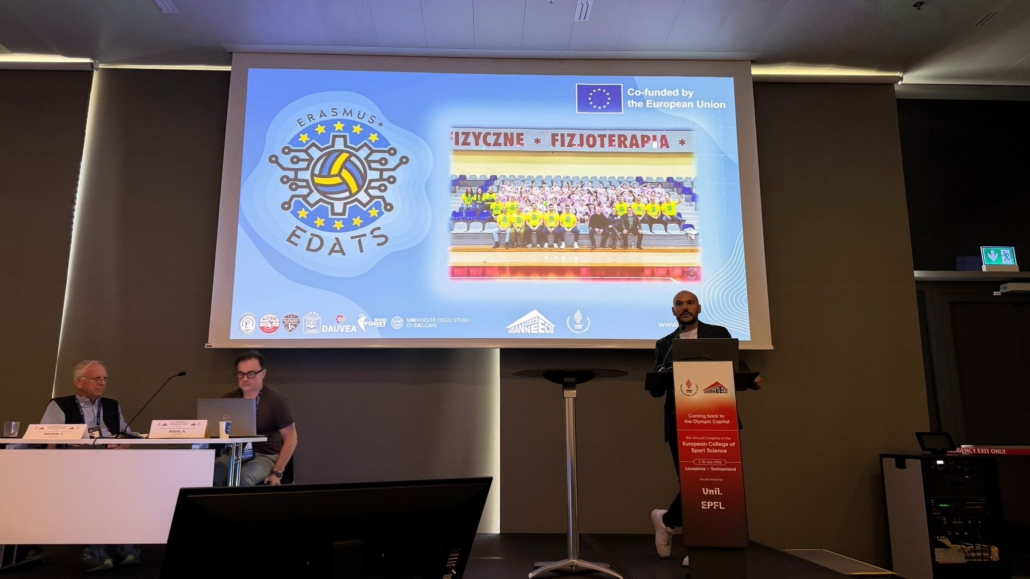
It was in this spirit that Dauvea took part in the 31st Annual Congress of the European College of Sport Science (ECSS) in Lausanne, contributing to the presentation of the scientific results of the European project EDATS – European Digital Assisted Training in Team Sports, funded by the Erasmus+ Sport programme.
In collaboration with the Laboratory of Biomechanics and Industrial Ergonomics of the Department of Mechanical, Chemical and Materials Engineering at the University of Cagliari, a framework based on low-cost IMU sensors was presented for assessing athletes’ jump performance and dynamic stability, designed for use directly on the field of play.
For Dauvea, this achievement also stands as important evidence of the value of continuity in research and innovation. The scientific, methodological and technological expertise built up by the Dauvea team over years of industrial research activities — including the JADA project — provided the body of knowledge and experience that made it possible to develop the activities set out in the EDATS project. EDATS in turn pursued its own scientific and applied objectives, defined by the Erasmus+ Sport programme and delivered within the international partnership.
Today the EDATS platform is used by the project partners for the longitudinal monitoring of athletes, supporting data collection and analysis in order to improve sporting performance, contribute to injury prevention and encourage the development of new training approaches based on objective data.
We would like to thank you once again for giving the EDATS project the opportunity to be presented at the ECSS 2026 congress.
It was a great honour to see the results of the EDATS project presented at the 31st Annual Congress of the European College of Sport Science (ECSS), one of the most important European scientific events in the field of sport science, held in Lausanne.
The congress brought together more than 3,000 researchers, university lecturers and innovation experts in the field of sport science, from over 70 countries worldwide.